
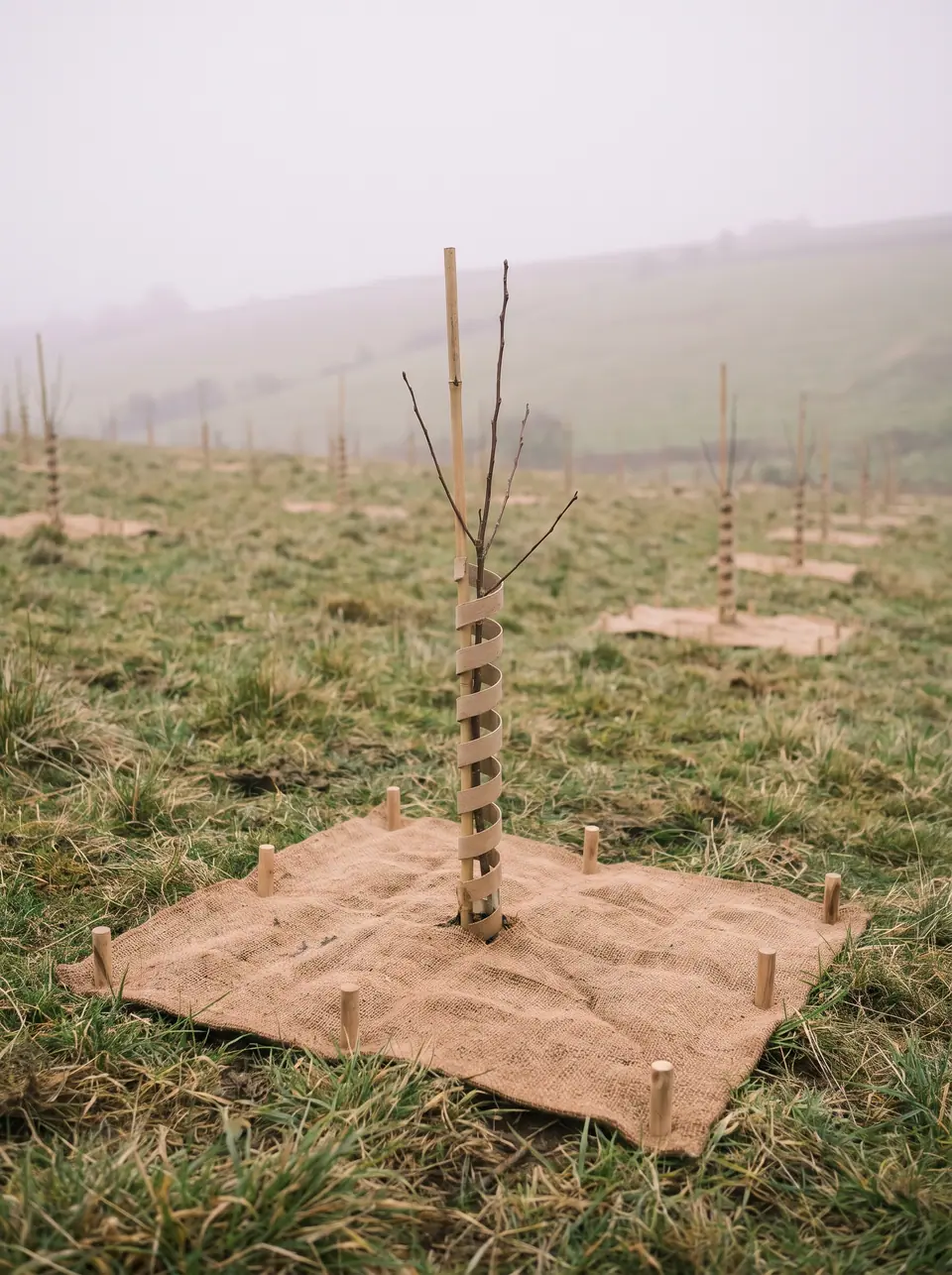
The short answer
A mulch mat is a sheet of natural fibre, usually jute or wool, laid on bare soil around a new tree, hedge or planting. It blocks the light weed seeds need while letting rain through. Choose the size to cover the root zone (Forest Research recommends a 1.2 m weed-free spot), the weight for how robust you need it, and peg it down firmly.
- A mulch mat blocks light to stop weed seedlings while letting water through.
- Forest Research recommends a 1.2 m weed-free spot; EWCO funds mats of at least 50 × 50 cm.
- Heavier is not automatically longer-lasting: our A8 450 and 750 g/m² grades are both rated about 2 seasons.
- PLA-backed mats break down more slowly than all-jute ones; AH17 and A25 use a hessian scrim instead.
- Peg every mat firmly and check it each year, because weeds can still seed into debris on top.
What is a mulch mat, and do mulch mats really stop weeds?
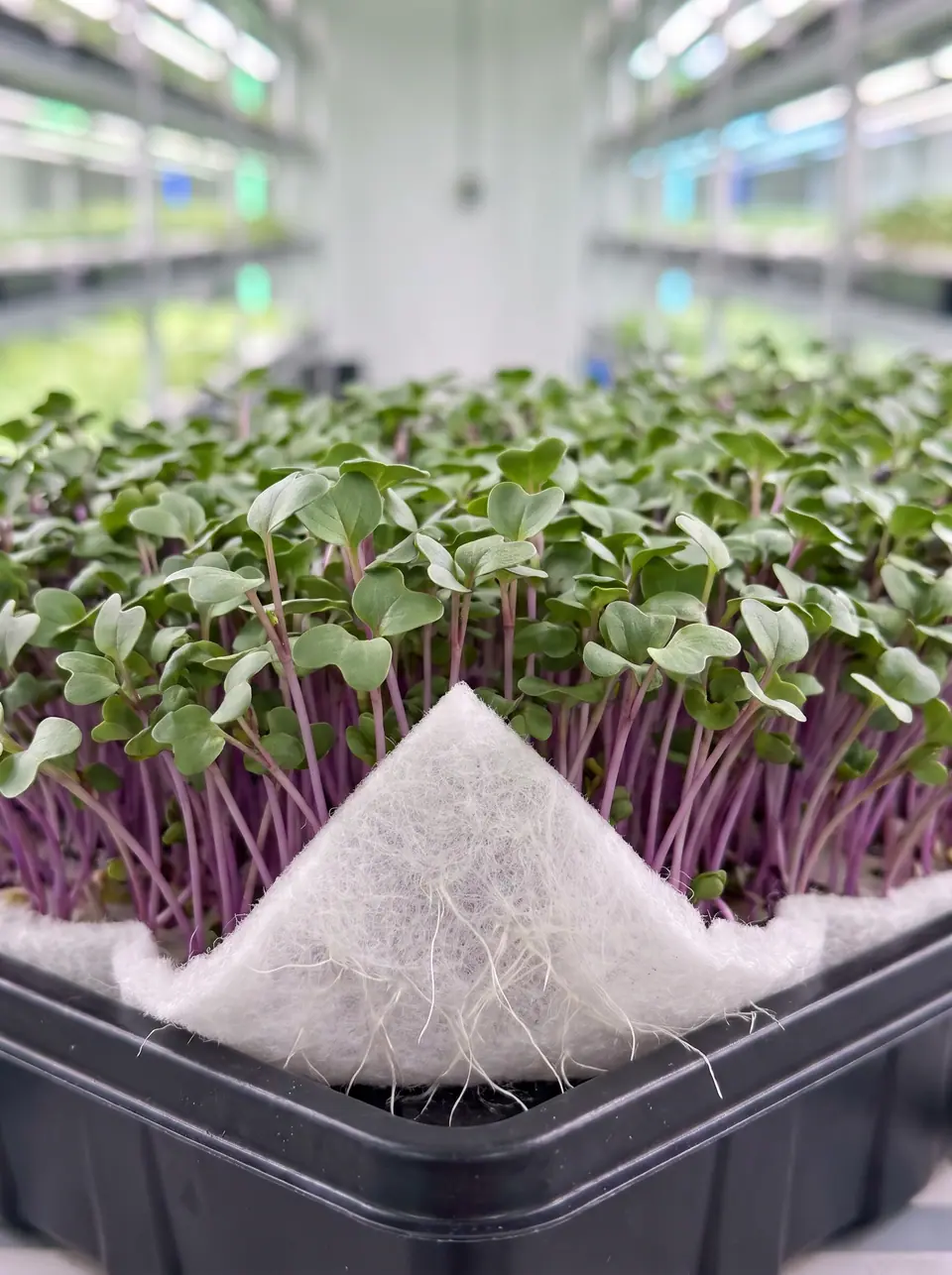
A mulch mat is a flat sheet or square of dense fibre laid on the soil surface around plants. Mulch matting does the same job as a thick layer of bark or woodchip: it shades the soil so weed seeds can't germinate and grow, and it slows evaporation so young roots stay moist. Unlike a loose mulch, a pegged mat stays in place on banks and in wind.
Do mulch mats really stop weeds? They stop most weeds that would grow from seed in the soil underneath, which is the main competition for a newly planted tree or hedge. They won't kill established perennial weeds, so lay mats on cleared ground. And they can't stop seed blowing onto the top of the mat and rooting in leaf litter or soil that collects there, so a quick check once a year is part of the job.
Our jute mats are designed to retain moisture in dry conditions but let it pass through in wet conditions, suppressing weeds without chemical treatment, and to protect bare soil from compaction and erosion while plants establish.
Mulch mat vs weed membrane vs loose mulch
All three block light. The differences are in how long they last and what happens afterwards.
| Jute or wool mulch mat | Polypropylene weed membrane | Loose organic mulch (bark, woodchip) | |
|---|---|---|---|
| How it stops weeds | Blocks light at the soil surface | Blocks light | Blocks light if deep enough: the RHS says 5–7.5 cm |
| Water | Lets rain through | Choose a permeable type: the RHS warns a waterproof layer causes run-off | Lets rain through |
| Lifespan | About 2–3 seasons for our jute grades, site dependent | Longer; does not break down | Needs topping up |
| End of life | Breaks down in place (PLA backings more slowly) | Must be lifted and disposed of | Rots into the soil |
| Best for | New trees, hedges and landscape planting where the mat should disappear | Long-term paths and areas under gravel | Beds, borders and established trees |
A plastic membrane is the better choice where you want permanent cover under gravel. For planting that should establish and then look after itself, a natural mulch mat avoids having to dig plastic out of a hedge line later.
What gsm mulch mat do I need?
Weight (gsm, or g/m²) tells you how much fibre is in the mat. Heavier mats are thicker and more robust, but heavier does not automatically mean longer-lasting: our A8 jute grades at 450 and 750 g/m² are both rated at about 2 seasons.
| Grade | Fibre and backing | Weight | Thickness | Rated life (approx., site dependent) | Formats |
|---|---|---|---|---|---|
| A8 PLA Jute 450 | Jute, 40 g/m² PLA backing | 450 g/m² | 5 mm | 2 seasons | 500 × 500 and 1,000 × 1,000 mm mats; rolls 1 or 2 m × 25 or 30 m |
| AH17 Jute 575 | Jute, hessian scrim | 575 g/m² | 5 mm | 2–3 seasons | 500 × 500 and 1,000 × 1,000 mm mats; 1 or 2 m × 25 m rolls |
| A8 PLA Jute 750 | Jute, 40 g/m² PLA backing | 750 g/m² | 6.5 mm | 2 seasons | 500 × 500 and 1,000 × 1,000 mm mats; 1 or 2 m × 30 m rolls |
| AH17 Jute 800 | Jute, hessian scrim | 800 g/m² | 6 mm | Ask us | Cut to order; 1 or 2 m wide rolls |
| A25 Wool 450 | Wool blend, hessian scrim | 450 g/m² | 5 mm | Ask us | 500 × 500 and 1,000 × 1,000 mm mats; 1 m × 30 m rolls |
AH17 also comes at 450 g/m². As a starting point, 450 g/m² suits standard tree and hedge planting on cleared ground. Step up to 575–800 g/m² where weed pressure is heavy or the mat needs to stand up to more wear.
Jute, wool or PLA-backed? How the backings differ
The fibre layer does the weed suppression; the backing holds it together during handling and fixing.
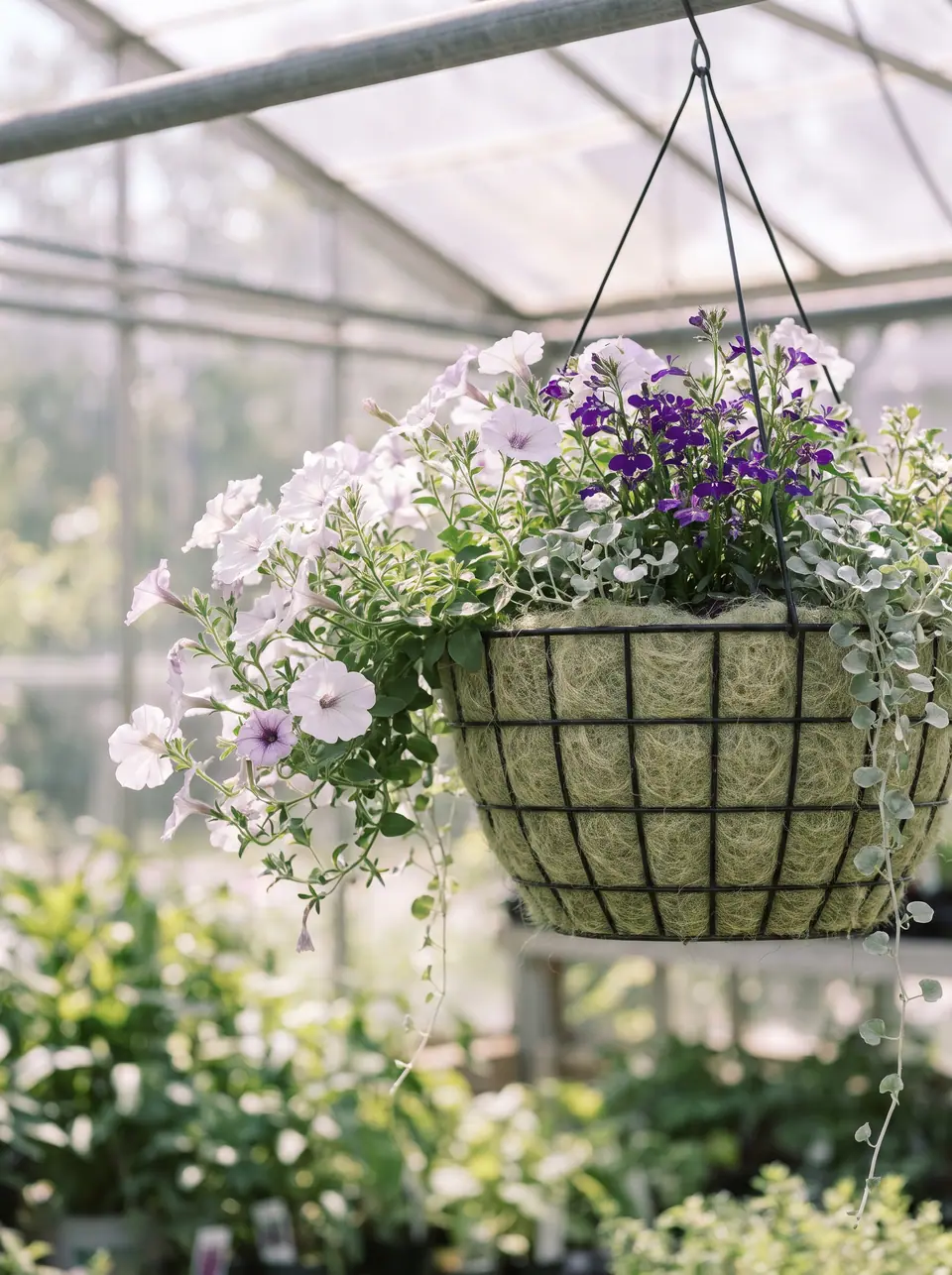
A8 grades have a 40 g/m² PLA backing on the underside, needled tightly into 100% jute fibre. The A8 mats won't fray or tear at the edges. PLA is a plant-based polymer, but it breaks down reliably only in industrial composting and much more slowly in soil. In a 2024 open-field study, adding PLA fibres to jute and hemp nonwoven mulches slowed their breakdown, and PLA fibres remained after the all-jute and all-hemp mulches had fully degraded (Kopitar et al.). That extra durability can be useful, but the backing lingers after the jute has gone. The same applies to PLA-backed hanging basket liners.
AH17 jute and A25 wool grades use a hessian support scrim, a woven jute fabric, in place of PLA. If your specification excludes plastics, including bioplastics, these are the grades to look at, and we can confirm the full construction for your order.
Wool or jute? Wool contains about 16–17% nitrogen (Camilli et al., 2025), and research on nonwoven wool mulches found them effective for weed suppression. Jute gives the familiar hessian look.
What is the best thing to put around the base of a tree?
For a newly planted tree, the aim is a weed-free circle while the roots establish. Forest Research guidance says mulches should create a 1.2 m diameter weed-free spot to stop weed roots creeping in from the edges, and notes the establishment phase may last up to five years.
If your planting is funded through the England Woodland Creation Offer, the standard cost item for mulch mats is £1.79 each. It requires a biodegradable mulch mat at least 50 cm × 50 cm, pegged down with 5 non-plastic pegs, supports mulch mat rolls as an alternative, and asks for pegs to be collected and reused or recycled once the mats have degraded.
That gives three practical options:
- 500 × 500 mm mats meet the EWCO minimum and suit whips and small transplants.
- 1,000 × 1,000 mm mats come closer to the Forest Research 1.2 m spot for standards and feathered trees.
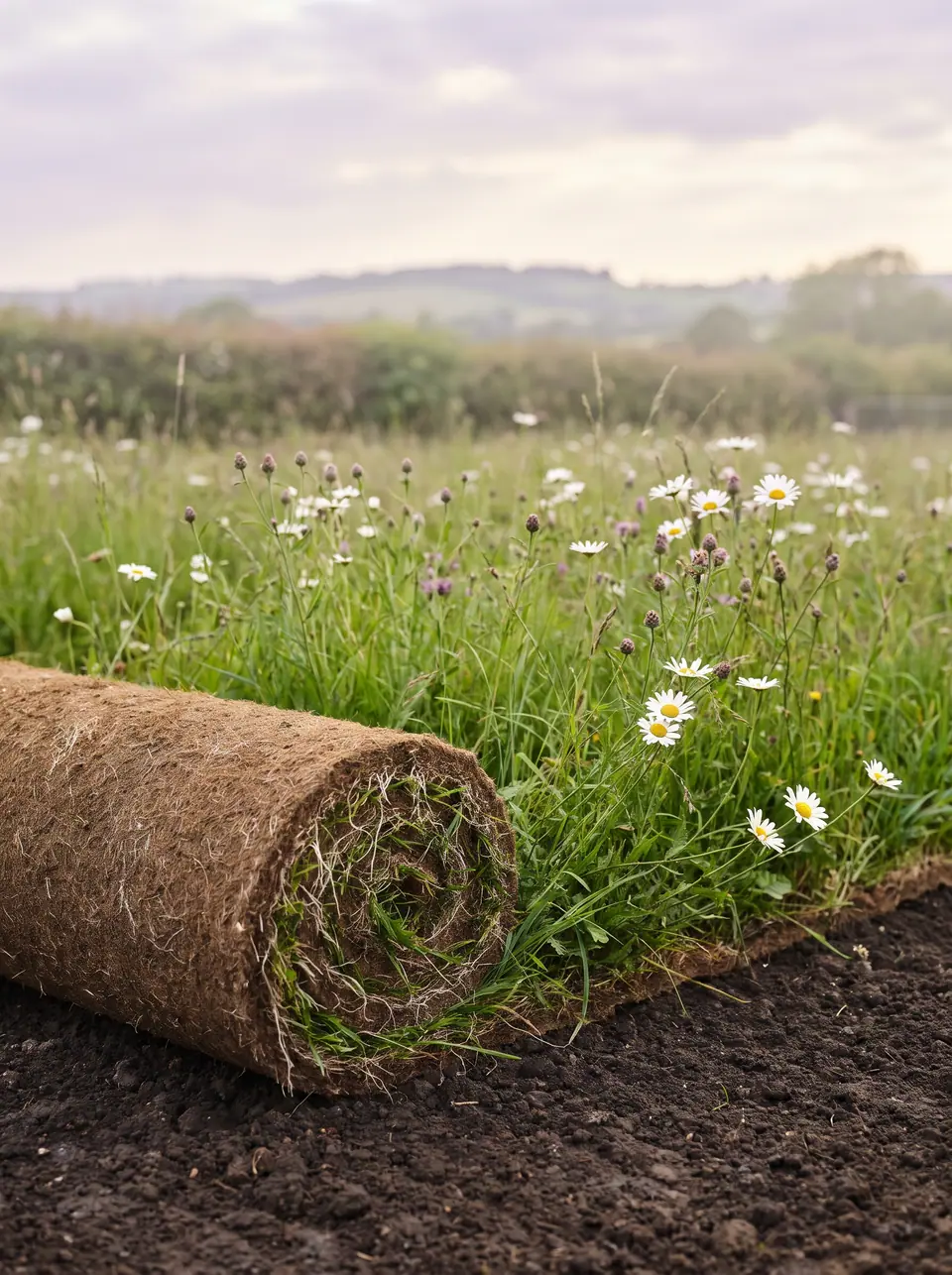
- Rolls 1 m or 2 m wide cover a whole hedge line in one run.
For established specimen trees, the RHS advises mulching to the radius of the canopy with a loose organic mulch at least 5 cm and ideally 7.5 cm deep.
How to fit a mulch mat: step by step
- Clear the ground of existing weeds, especially perennials.
- Plant the tree or hedge first.
- Cut the mat to fit round the stem. For squares, cut a slit from one edge to the centre and slide the mat round the stem. For rolls, unroll along the row and, at each plant, cut an L-shape into the mat and fold the corner back.
- Lay it flat with full contact with the soil and no air pockets underneath.
- Peg it down firmly with pegs or steel pins at the corners and edges. EWCO-funded schemes require 5 non-plastic pegs per mat. Overlap joins between rolls or mats where you can.
- Fit the tree shelter or guard over the stem.
- Check once a year. Clear leaf litter and any seedlings rooting on top, and re-peg any lifted edges.
- Collect the pegs once the mat has broken down, for reuse or recycling.
How long does a jute mulch mat last?
Natural mulch mats are designed to last through establishment, not for ever. We rate our A8 jute grades at about 2 seasons and AH17 575 g/m² at about 2–3 seasons. Actual life varies with site conditions, installation and weather.
Forest Research notes that tree establishment may take up to five years. On sites with heavy weed pressure, plan for follow-up: a second mat, a loose mulch once the first has broken down, or spot weeding.
Mulch mats also protect bare soil from compaction and erosion while plants establish, which is why they are often used on landscaped banks. They are not engineered erosion-control blankets, though. For steep slopes, watercourses or civil engineering specifications, ask an expert before ordering.
For a single tree, a hedge or a whole planting scheme, compare the grades on free samples first, or browse the full mulch matting range.
Products mentioned
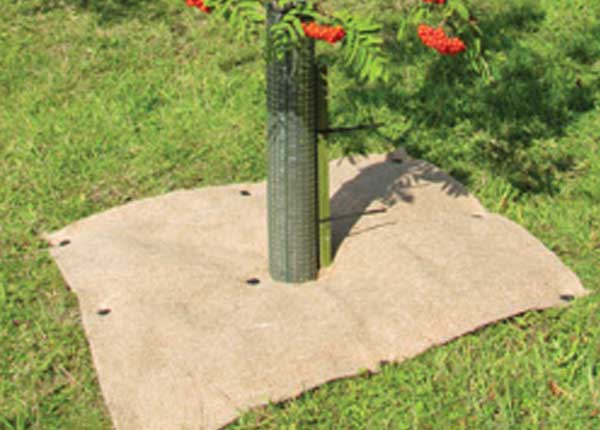 A8 PLA Jute Biodegradable Mats 450gsm
450 g/m² · 5 L/m² · 5 mm
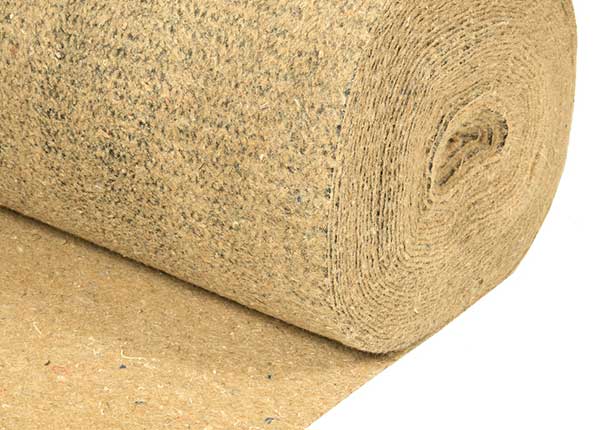 A8 PLA Jute Biodegradable Matting Rolls 450gsm
450 g/m² · 5 L/m² · 5 mm
- AH17 Jute Biodegradable Mulch Mat 575gsm
575 g/m² · 5 mm · 2-3 seasons (varies with site conditions, installation and weather)
- A25 100% Wool Biodegradable Mulch Mat 450gsm
450 g/m² · 5 mm
Sources
- Forestry Commission (GOV.UK) — England Woodland Creation Offer: standard cost items (updated Oct 2026)
- Forest Research — Best Practice Guidance Note 11: Land regeneration, weed control
- RHS — Mulches and mulching (checked 2026)
- Kopitar, Marasovic & Vrsaljko — PLA fibres in cellulose nonwoven mulch blends: an open field study, Polymers 16(2) (2024)
- Camilli et al. — Wool waste nonwoven mulches, Agronomy 15(2):446 (2025)
- AHDB — Chemical weed control in ornamental crops