
The short answer
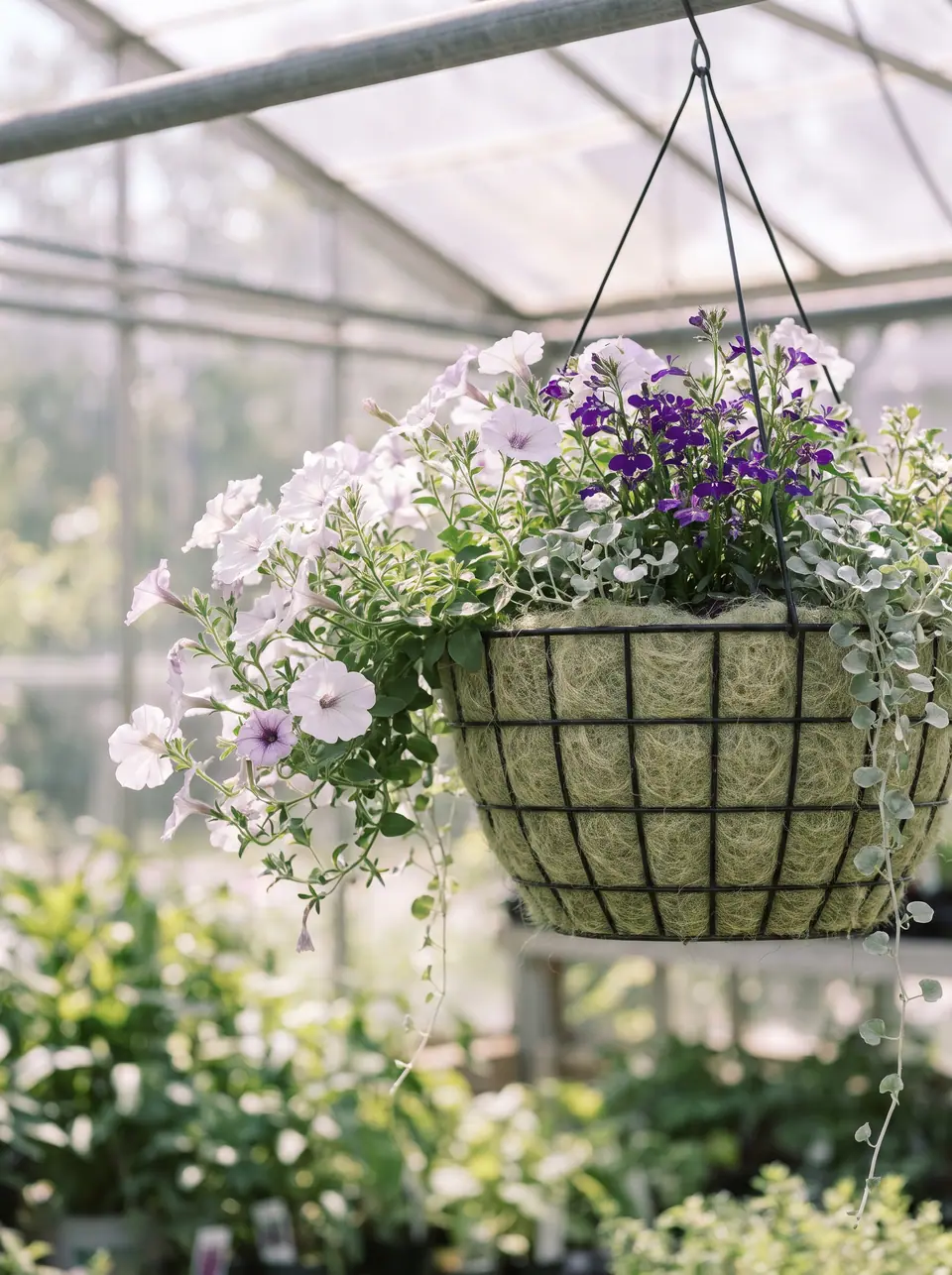
Line a wire basket with a material that holds water but still drains: wool, jute, coir, moss or a ready-made fibre liner. Press it into the frame, cut planting holes at least 10 cm above the base if you want to plant the sides, and fill with peat-free compost. No liner stops a basket drying out, so the RHS advises checking baskets every day in summer.
- Open wire baskets need a liner; solid plastic baskets with drainage holes do not.
- No independent trial has compared liner materials, so look for a stated water-holding figure.
- Greenwool liners hold 4.1 L/m² at 400 g/m² and 4 mm thick.
- Cut side planting holes at least 10 cm above the base (RHS).
- Buy sphagnum moss only if it is sustainably sourced; wool and jute give a natural look without it.
Do you need a liner for a hanging basket?
An open wire or metal-frame basket needs a liner, or the compost falls straight through. The RHS says a standard wire basket will need to be lined, and lists ready-made cardboard and fibre liners, moss from your own lawn, coir and jute as options. Solid plastic baskets don't need a liner as long as they have drainage holes. Iowa State University Extension points out that plastic is non-porous, so it dries out more slowly than a lined frame.
A liner does three jobs: it holds the compost in, it slows water loss through the sides, and it sets the look of the basket until the plants cover it. The RHS notes that hanging baskets dry out more quickly than other containers, and an open frame loses water through its sides as well as its base, so the liner matters more than people expect.
What is the best lining for hanging baskets?
The best hanging basket liner holds water, drains freely and suits the look you want. Here is how the common materials compare.
| Liner | Look | Water | End of season | Watch out for |
|---|---|---|---|---|
| Lawn moss | Natural green | Good if packed about 1.5 cm thick (RHS) | Composts | Slow to collect; thin patches let compost out |
| Sphagnum moss | Classic green | Good | Composts | RHS: avoid unless sustainably harvested |
| Coir (coco fibre) | Brown fibre | Drains well and absorbs some water (Iowa State) | Composts | Water runs through readily; a pierced plastic disc in the base slows it |
| Jute (A8 PLA Jute) | Natural brown | Absorbent; 450 g/m², 5 mm | Fibre breaks down; PLA backing needs industrial composting | Backing breaks down more slowly than the fibre |
| Wool (Greenwool Moss) | Moss-green blend | 4.1 L/m²; 400 g/m², 4 mm | Fibre breaks down slowly | A coloured wool blend, not real moss |
| Cardboard or pressed fibre | Plain | Varies by product | Composts | Best where plants will cover the sides |
| Plastic sheet | Hidden | Stops side losses | Waste | Use only as a pierced disc in the base |
No independent trial has compared liner materials for water holding, so the most useful guide is a stated L/m² figure and the thickness. Of our liners, Greenwool has a published figure: 4.1 L/m². A8 jute liners, made from recycled coffee sacks, are thicker at 5 mm and give a natural brown finish.
How to line a hanging basket: step by step
- Steady the basket. The RHS suggests standing it on a wide, short pot while you work.
- Choose the right liner size for the basket diameter (see the size table below).
- Press the liner into the frame so it follows the curve, with the top edge level with the rim. If you are cutting from a roll, cut a circle and make a few overlapping cuts (darts) so it sits flat.
- Optional: add a pierced plastic disc in the base only. Iowa State Extension suggests lining just a small part of the bottom with plastic and poking holes in it, to slow water running through so the compost wets more fully.
- Cut side planting holes if you want them, at varying heights and at least 10 cm up from the base (RHS).
- Plant the sides. Add peat-free compost up to the holes, wrap each root ball in a twist of newspaper, push it through from outside and cover the roots with compost.
- Plant the top. Trailing plants round the edge, taller ones in the middle, with the compost finishing just below the rim.
- Water slowly with a fine rose before hanging. The RHS advises planting summer baskets from late April, but protecting them from frost until late May or early June.
Do you put holes in a hanging basket liner?
It depends on the liner and on whether you want to plant the sides.
- Fibre liners (wool, jute, coir, moss) drain naturally and don't need drainage holes.
- Plastic always needs holes. Iowa State Extension advises poking holes in any plastic used in the base, so excess water can escape and roots don't sit waterlogged.
- Side planting holes are optional. The RHS says planting through the sides is not essential, but helps the basket look fuller more quickly. Keep them at least 10 cm above the base and only as big as the root ball needs.
A liner that fits snugly against the frame, with no gaps at the rim, loses less compost and water than one with folds and gaps.
What can I use instead of coconut liners?
If you want an alternative to coco liners, the main choices are:
- Wool. Greenwool Moss liners blend coloured and natural wools to give a moss-green look without harvested moss, and hold 4.1 L/m².
- Jute. A8 PLA Jute liners are made from recycled coffee sacks and give a natural brown finish.
- Moss from your own lawn, packed about 1.5 cm thick, which the RHS calls the thrifty option.
- Sphagnum moss, but the RHS advises avoiding it unless you are sure it was harvested from a sustainable source.
To make your own liner, measure across the inside of the basket from rim to rim, following the curve down through the base. Cut a circle of liner material to that diameter, then make four to six short cuts in from the edge so it folds neatly into the bowl. For wall baskets, troughs or large runs of baskets, liner material on the roll (Greenwool Moss rolls or A8 PLA Jute rolls) lets you cut your own shapes.
Hanging basket liner sizes
Our pre-cut liners fit four standard basket sizes. The liner size is larger than the basket's diameter because the liner has to follow the curve of the bowl.
| Basket diameter | Liner size |
|---|---|
| 12 inch (about 30 cm) | 476 mm |
| 14 inch (about 36 cm) | 533 mm |
| 16 inch (about 41 cm) | 602 mm |
| 18 inch (about 46 cm) | 721 mm |
Both Greenwool Moss and A8 PLA Jute liners come in all four sizes. For garden centres, nurseries and councils planting many baskets, ask an expert about rolls and trade quantities.
Are hanging basket liners biodegradable?
Natural liners break down, but at different speeds, and backings matter.
- Moss and coir compost easily at the end of the season.
- Greenwool is a blend of coloured and natural wools on a biodegradable backing. Wool is about 16–17% nitrogen (Camilli et al., 2025) and releases it slowly as it breaks down. That is a bonus, not a substitute for feeding: the RHS recommends liquid feeds for summer baskets.
- A8 PLA Jute liners, like the rest of the A8 range, use a PLA backing. PLA is a plant-based polymer that breaks down reliably in industrial composting but slowly in soil or a garden heap. A 2024 open-field study found that PLA fibres slowed the breakdown of jute and hemp nonwoven mulches (Kopitar et al.). Our mulch mat guide covers backings in more detail.
- Plastic sheet does not break down.
At the end of the season, shake out the old compost, cut the liner into pieces to help it rot down, and check your council's rules on what its green-waste collection accepts.
Products mentioned
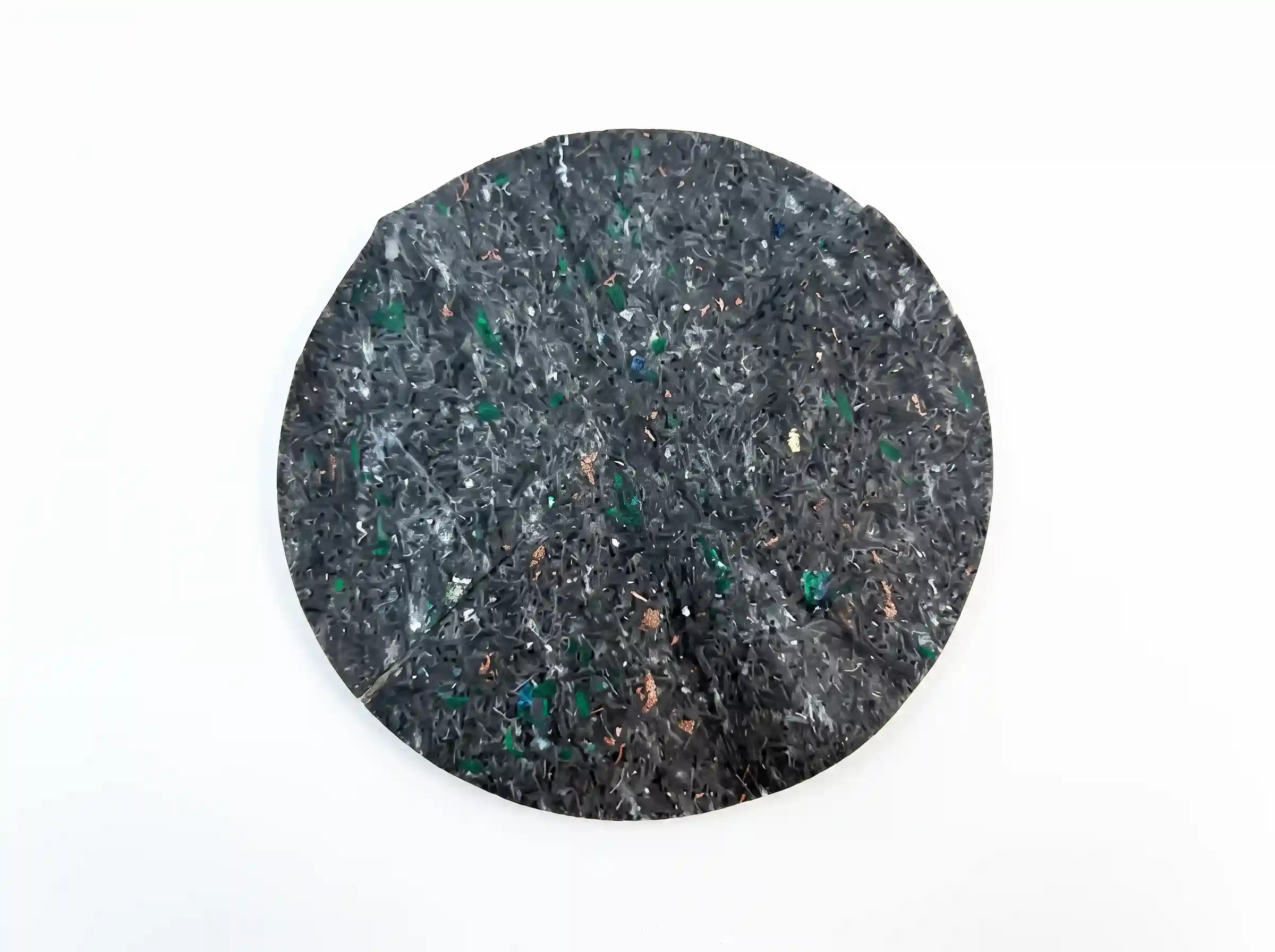 Greenwool Moss Basket Liners
400gsm · 4.1 Litres/m² · 4mm
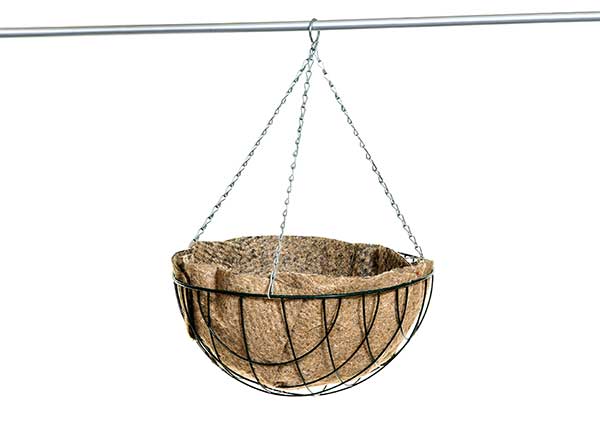 A8 PLA Jute Basket Liners
450gsm · 5mm
Sources
- RHS — Hanging baskets (checked 2026)
- RHS — How to plant a hanging basket (checked 2026)
- Iowa State University Extension — Creating and growing hanging baskets (2026)
- Camilli et al. — Wool waste nonwoven mulches, Agronomy 15(2):446 (2025)
- Kopitar, Marasovic & Vrsaljko — PLA fibres in cellulose nonwoven mulch blends: an open field study, Polymers 16(2) (2024)