The short answer
There is no single best medium: it depends on the crop, your system and how you sell. Compost is forgiving but can leave particles on the cut crop. Fibre mats (felt, hemp or jute) give a clean, soil-free harvest and suit hydroponic trays. In a peer-reviewed trial, recycled textile-fibre and jute–kenaf mats yielded as much as peat for rapini microgreens.
- Microgreens grow well without soil, and a fibre mat gives a clean cut.
- In a peer-reviewed trial, recycled textile-fibre mats yielded as well as peat for rapini microgreens.
- Natural-fibre mats compost; synthetic felts are more consistent but do not compost.
- Match thickness and water holding to seed size: thicker mats for pea shoots.
- Selling microgreens means registering with your council at least 28 days before trading.
Can you grow microgreens without soil?
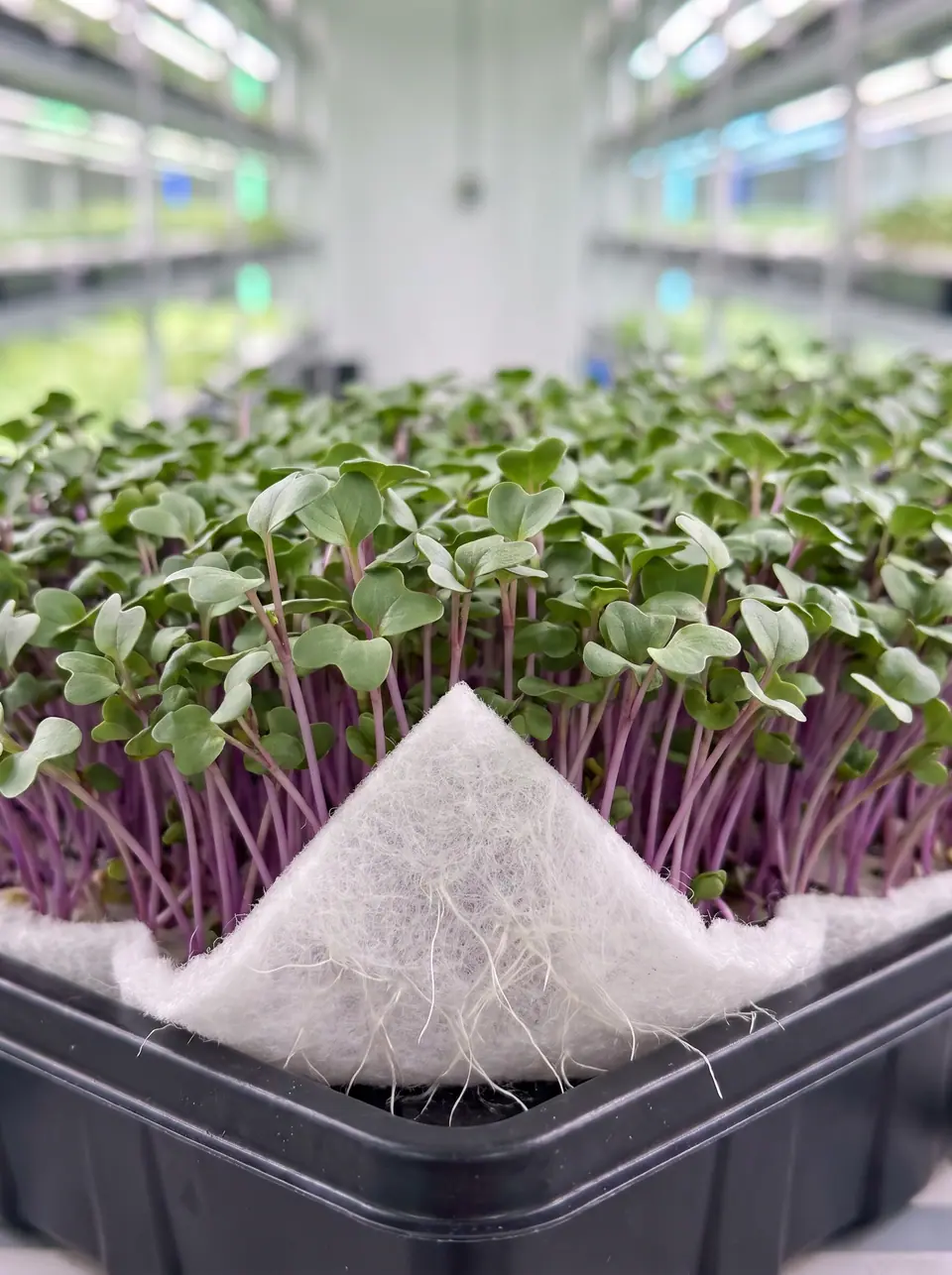
Yes. Microgreens are cut young, just above the growing surface, so the medium mainly has to hold water evenly and give roots something to anchor into. A fibre mat does both without the loose particles that end up on a soil-grown crop. That is the main reason growers choose mats: the cut crop goes into the pack clean, and trays are quicker to turn round.
Growing microgreens without soil is often called hydroponic microgreens. In practice, seed is sown on a wetted mat in a tray and kept moist by hand, by a flood-and-drain bench, by an irrigation line or from below on capillary matting, then harvested with a sharp blade just above the mat. Seeds carry their own food reserves through germination, and some growers add a dilute nutrient solution for longer crops such as baby leaf.
The choice of microgreen growing medium then comes down to five things: how clean the harvest is, how consistent the medium is from batch to batch, how much water it holds, what happens to it after the crop, and cost per tray.
Microgreen growing media compared
| Medium | Harvest | Consistency | After the crop | Points to know |
|---|---|---|---|---|
| Peat-based compost | Can leave particles on the crop | Varies by mix | Composts | Highest E. coli and Enterobacteriaceae counts of four media in Di Gioia et al. (2017) |
| Peat-free compost or loose coir | Loose coir is messy | Salt content and texture vary | Composts | Cheap and forgiving |
| Hemp mat | Clean | Growers on microgreen forums report batch-to-batch variation and loose fibres | Composts | Natural fibre |
| Jute or jute–kenaf mat | Clean | Varies with the fibre source | Composts | Matched peat yield in Di Gioia et al., with higher yeast and mould counts than textile mats |
| Recycled textile felt, such as Growfelt | Clean | Weight held to ±5% | Does not compost | Matched peat yield in Di Gioia et al. |
| PET (polyester) pad | Clean | Uniform | Does not compost | Yield 13.1% lower than peat in Di Gioia et al. |
| Stone wool (rockwool) | Clean | Uniform | Does not break down | Common in hydroponics; needs a disposal route |
The table compares handling, not price. Cost per tray depends on your tray size, seed rate and volumes, so compare media on a trial run rather than on the price per roll or bag.
What does the research say about mats versus peat?
The most useful study is Di Gioia et al. (2017), published in the Journal of the Science of Food and Agriculture. The team grew rapini microgreens on peat, a recycled textile-fibre mat, a jute–kenaf mat and a PET mat, and found:
- Yield: an average 1,502 g/m² of fresh microgreens on peat, the textile-fibre mat and the jute–kenaf mat alike. The PET mat yielded 13.1% less.
- Nitrate: shoots grown on peat had about twice the nitrate of mat-grown shoots (1,959 vs 940 mg/kg fresh weight).
- Hygiene: E. coli was found only on peat-grown microgreens. Yeast and mould counts were higher on peat and jute–kenaf than on the textile and PET mats.
The authors concluded that recycled fibrous materials may be low-cost, renewable alternatives to peat and synthetic mats.
Two cautions. This was one crop in one trial, so it does not prove that felt beats peat for every microgreen. And no growing medium makes a crop safe on its own: clean seed, clean water and careful handling matter more.
Hemp vs jute vs felt mats
Hemp mats are a popular natural option and compost with the root mat after harvest. Growers on microgreen forums report good results from some batches and poor results from others, and loose fibres getting into the cut crop.
Jute and jute–kenaf mats are renewable and compostable. In the Di Gioia trial, jute–kenaf matched peat for yield but carried higher yeast and mould counts than the textile-fibre and PET mats.
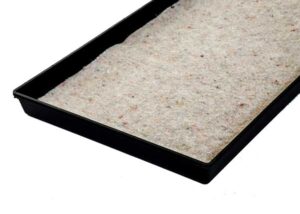
Felt mats are needle-punched fibre. Growfelt Purple is recycled acrylic, Growfelt White a viscose blend, and Growfelt Wool is made from recycled carpet, each on a thin spunbond support scrim. Weight is held to ±5% and thickness to ±0.5 mm, so one roll behaves like the last. The honest downside: these felts do not compost, so plan how you will dispose of used pads.
Coir is cheap and forgiving, but loose coir is messy on the crop and varies in salt content.
If you want a natural-fibre mat, hemp or jute is the obvious choice. If consistency and a clean lift-out matter more, felt is worth trialling. We also offer Growfelt Bio: ask an expert for its current specification.
Which felt weight for which crop?
As a rule of thumb, small seed on a short cycle needs a lighter mat. Large seed such as peas needs a thicker mat with more root room and a bigger water reserve.
| Grade | Weight | Water holding | Thickness | Suits |
|---|---|---|---|---|
| Growfelt Purple 275 | 275 g/m² | 3.5 L/m² | 4 mm | Cress, sprouts, micro herbs, micro leaf |
| Growfelt Purple 400 | 400 g/m² | 4.5 L/m² | 5 mm | Longer cycles and baby leaf; more reserve between waterings |
| Growfelt White 275 | 275 g/m² | 2.5 L/m² | 4 mm | White face for light reflection; holds less water than Purple |
| Growfelt White 600 | 600 g/m² | Ask us | 5.5 mm | Heavier white grade |
| Growfelt Wool 300 / 500 | 300 or 500 g/m² | Test data on request | 6 mm | Pea shoots and larger seed |
Intermediate Purple weights between 275 and 400 g/m² can be made to order. Every grade comes on the roll (Purple and White up to 4.3 m wide) or as cut pads. Trial rolls of 1 m × 10 m let you run a full bench before you commit. See the full growing media range.
Are microgreen grow mats reusable?
Plan on one crop per mat. Roots grow through the fibre and the cut stubs stay behind, so a used pad is hard to clean to the standard you would want for a food crop. The tray is the part you reuse.
What happens to the used mat depends on the material:
- Hemp, jute, coir and compost go on the compost heap with the roots.
- Synthetic felts and PET pads do not compost. Growfelt felts are recycled acrylic, viscose or recycled carpet fibre on a spunbond scrim, so treat them as general waste unless you have a textile recycling route.
- Stone wool does not break down and needs a separate disposal route.
Weigh this against the clean harvest and consistency when you work out the real cost per tray, and ask an expert if you would like to discuss disposal for your volumes.
Do you need a licence to sell microgreens in the UK?
There is no specific licence for ordinary microgreens, but you do need to register. Food Standards Agency guidance says anyone who sells, handles, stores, prepares or distributes food may be a food business and must register with their local authority at least 28 days before they start trading. Registration is free. It applies whether you trade from home, online, from a market stall or from a unit. A market or street-trading pitch may need its own permit, so check with the operator.
Microgreens and sprouts are treated differently. Retained UK law defines sprouts as seeds germinated in water or another medium, harvested before true leaves develop and eaten whole, including the seed. Sprouts carry extra traceability and testing rules. Microgreens cut above the mat, without the seed, fall outside that definition. If you plan to sell sprouts as well, speak to your council's food team first.
If you are building a microgreens business, register early, then trial your medium at scale before you commit to volume.
Products mentioned
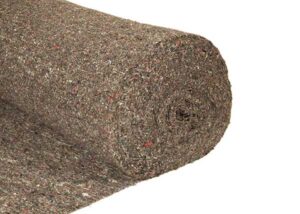 Growfelt Purple
275 / 400 g/m² · 275G: 3.5; 400G: 4.5 L/m² · 275G: 4; 400G: 5 mm
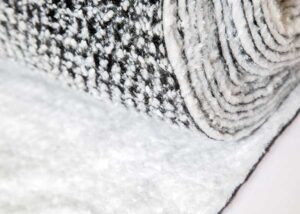 Growfelt White
275–600 g/m² · 275 gsm grade: 2.5 L/m² · 275G: 4; 600G: 5.5 mm
 Growfelt Wool
300 / 500 g/m² · 6 mm
Sources
- Di Gioia et al. — Microgreens grown on peat and fibrous mats, J Sci Food Agric 97(4) (2017)
- Food Standards Agency (GOV.UK) — Starting a food business (updated 2026)
- legislation.gov.uk — Regulation (EU) No 208/2013, Article 2: definition of sprouts (retained)
- RHS — How to grow peas, including pea shoots (checked 2026)